This is why I have such a hard time with Math….

Do you think it’s possible to be too logical for math? Follow this thread below, and see my question and my professors response… It legitimately looks to me like you can’t figure out the order of operations in a word problem unless you know what you’re answer is supposed to look like… does that mean the rules of the order of operation doesn’t necessarily apply without some other external logical application?


I think this is why math frustrates me – I probably just over think everything. =(


My Original Question:

Content Author: Jed Logiodice

When determining BAC (page 34), the following word problem is given:

BAC = number of oz X % alcohol X 0.075 / body weight in lb – hr of drinking X 0.015.

To simplify the question let w = number of ounces, let x = % of alcohol, let y = body weight and let z = hours of drinking.

When the book gives the BAC equation of being:

w * x * .075 / y – z * .015

This can create an order of operation like this (w * x * .075 / y) – (z * .015) [which results in the answer the book is looking for], however, why could one not equally contrive the following equation out of the above word problem:

(w * x * .075)
___________
y – (z * .015)

The way the word problem is written, it appears equally valid to assume either order of operation – however, unless one assumes the first, the answer will not match what the book states it should.

Is there some rule of order of operations that I’m missing for word problems that says “Never use fractional notation, unless the question is asking for a fraction”?

Thanks!


My Professors Response:

(w * x * .075 divided by y) – (z * .015)
Note: I have added parentheses to show that we do ALL multiplication and division from left to right before any addition or subtraction.

w = 4 * 12 = 48 oz

(w * x * .075 divided by y) – (z * .015)
(48 * 3.2 * .075 divided by 190) – (2 * .015)
= (153.6 * .075 divided by 190) – (2 * .015)
= (11.52 divided by 190) – (2 * .015)
= (.060631578) – (2 * .015)

Remember, we do ALL multiplication and division from left to right before any addition or subtraction so our next step is to multiply 2 * .015

= (.060631578) – (2 * .015)
= (.060631578) – (.03)

= .030631578

Rounded to the nearest thousand (3 digits to the left of zero), we have .031 as our answer


My Follow up Question:

Author: Jed Logiodice

But when I read the statement I saw this:

(w * x * .075)
____________
y – (z * .015)

instead of this (w * x * 0.75 / y) – (z * 0.15).

i.e. how was one to know that it was intended to be a linear equation (where the rules of operations went across from left to right, instead of above and below the division line separately).

I really thought that (w * x * .075) was the dividend and (y – (z * .015)) was the divisor…

Does that make sense?

I know it might seem like a foolish question; but I literally spent like 20 minutes doing that question over and over and over and never getting the right answer (but always getting the same answer); until I accidentally figured out that it was just a single linear equation, and then I started to ask myself “How was I supposed to know that, other than just assuming, was there some clue I missed”?

My single biggest problem with math is that I way over-think things!


My Professors Follow up Response:

One should always assume that we should follow the order of operations unless brackets or parentheses or a fraction bar is in the formula. OK?


My Follow up Request:


Even in word problems?

Take for example this problem: If you take 6 eggs and divide them among 2 women and 1 man, how many eggs does each person have?

If we always keep the order of operations (without brackets in the sentence) then the answer is (6 / 2) + 1 = 4; 4 Eggs a piece is obviously the wrong answer in this case – although it meets the rule of the order of operations we’re describing.

However, it would seem more logical (and in this case correct) to do 6 / (2 + 1) = 2. This gives the right answer (which we can verify because we know what the value should be), but doesn’t follow our prescribed operational rule.

Taking this discussion back to the case of the BAC – the same logical argument could be applied to the word problem, causing one to interpret the problem with a numerator and a denominator as a fractional statement, rather than just a linear equation – but one wouldn’t necessarily know that the answer was wrong (and what real order of operation was intended), unless one knew what the answer was supposed to be…

So I’m still left wondering – how we can tell in a word problem like the BAC what the real order of operation is supposed to be – without knowing what the answer is supposed to be?

I apologize if this appears as sophistry… I’m legitimately trying to figure out why I had the wrong answer; when from my viewpoint the way I executed the problem was equally as accurate as the way the book did.

Perhaps I’m too logical for math? 🙁
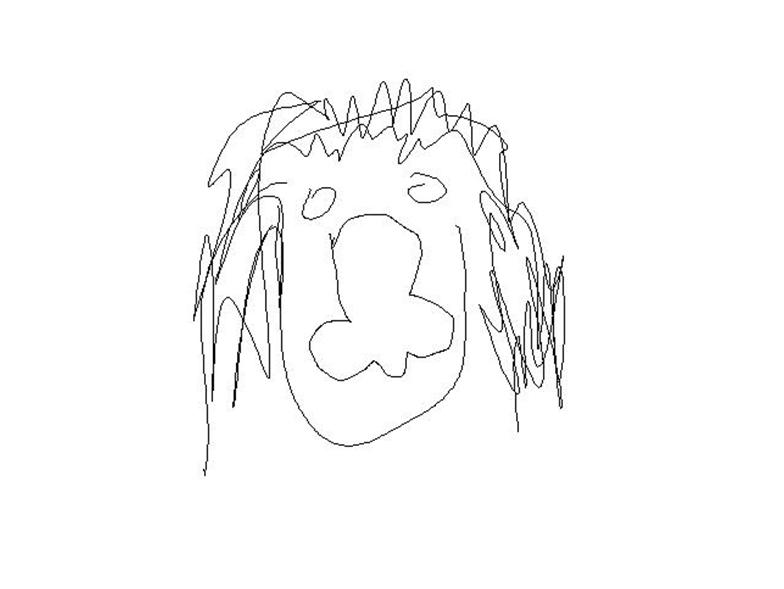
Caricature of Mandy

Ok, so I really am, honestly, the worst artist in the world – I know that, I’ve accepted that… but tonight, while using Skype to talk to Amanda in the next room (to her annoyance) – I decided to draw a caricature of her. Now, the funny thing is, I envisioned this skinny lean face with this big round nose – because of the way she was looking into the monitor of the computer screen – her nose looked accentuated – bigger than it normally looks..


So I grab my pen, and start inking – and this is what I came up with… then I laughed for about 15 minutes – but apparently she didn’t find it as humorous as I did.


Oh well – not everyone has such a great sense of humor…

My statement of Belief

I believe that the creation of the universe and life is the act of an intelligent creator; that contingent beings or creations cannot be created except that there be some non-contingent being whose very nature provides and requires aseity and eternality in its nature.

I believe that true science and true religion do not contradict each other rather they uphold and support each other, and as Sir William Bragg said that Science and Religion are opposed, only such as the forefinger and the thumb are opposed. That with Science and Religion together, you can grasp anything.

I believe that the state of the world today is not as it was intended to be; the wars, the hunger, the death, pain and dying. I believe it is the result of a disobedience to a given mandate provided by the creator of life and the universe.

I believe that our cultural mandate as human beings is to work to restore the original state of creation; by learning to love and provide for other people as we love and provide for our own.

I believe that our religious experiences should not be held separate from all other experiences in our world, and that a world view must remain consistent in all areas and portions of life and existence.

I believe in life after death, that mankind was created with value that extends beyond the dust of the earth and that our experiences, our trials and our undertakings here encourage, strengthen and prepare us for a future life that will unfold through the annals of history.

My Letter to God

Dear Lord,

I was asked to sit down today and think about my strengths and think about my weaknesses, and this is what I came to realize:

I am weak, but you are strong. However, I have found that I can do all things when you strengthen me. When I think I know something, when I think I understand, I find I am a fool. You alone are wise. When I ask of you, you give me freely of the fountain of your wisdom. I confess that I am selfish, and self-willed, but you are compassionate and shelter even the smallest of your creation. Through you I understand pure and undefiled religion. I lose my cool so quickly Lord, but you are slow to wrath. Through your patience I learn to wait on you and you give me strength. I am unloving and calloused, I mistreat even those closet to me, but you are love Lord, you love even those who despise you, and through you I find compassion for your creatures.

I realize that I am weak in all things, but through your sufficiency your power is made manifest in me, you strengthen me in all things, and I am reborn:

Lord, I am yours.

Your son,

Jediah


So what came before that?


This thought came from a “What caused the Big Bang” type of discussion.


Something had to cause the Big Bang, unless the Big Bang always existed (which is not possible, as it would have always existed as a point of singularity unless acted upon by an outside force – so then the question would be where did that force come from, and you would end up in a impossible series of circular questioning).


So, when discussing the Big Bang – something caused it – it is not possible to have something come from nothing (ex nihilo nihil fit) [Out of nothing, nothing comes].


In order for something to come from nothing, it would have to create itself. And something would have to predate itself before it could create itself. That is, it would have to exist, before it existed. This is a logical impossibility.


Nothing has ever come from nothing – philosophically and logically speaking, if there was ever a point in existence where nothing existed, then nothing would still exist – and because we do exist, we know there was never a time when nothing existed (Thomas Aquinas makes this argument in his Quinque Viae).


In fact, not even God could create himself; therefore God must have always existed (which is a central claim to the Judeo-Christian doctrine).


Additionally, God would be changeless (RE: The same, yesterday, today and tomorrow) – another foundational claim to central Judeo-Christian teaching, and God would need nothing, He would be complete and whole in his personage, being able to exist eternally without input or output (another central claim to the Judeo-Christian doctrine).


🙂

Predators in the dark

Ok, we’ve seen them down the road before; and we’ve heard them out in the woods – and I once even witnessed a pack take down a deer a couple miles from here – but when they show up in your back yard, licking their chops (I have chickens and children) – what are you supposed to do?

They’re almost to magnificent to kill – but I think the winter kill of the deer last year was so significant that we’re likely to have a big problem with them this year….

The Unnoticed War?

Wow! I’m watching Expelled: No Intelligence allowed right now. While I know that today biology speaks strongly against the undirected, random chance of evolution; most people do not.

Most people think of evolution as classical Darwinism (random and accidental), despite what science is now teaching about what appears to be design in creation. That’s typically because of the polarization that the secular and religious world views continue to propagate against each other – speaking at each other, instead of to each other.

However, above it all, understanding that the views of classical Darwinism is more than just a theoretical discussion – it is surprising to begin to understand how much classical Darwinism has really brought to our society: Nazism, Abortion, Eugenics and Euthanasia to name just a few.

I’ve never thought of the full implications of classical Darwinism – but now that I’ve been exposed to it – I can now see that for one to remain consistent with their world-views; if one was to fully embrace classical Darwinism, those other positions must necessarily follow.

Perhaps there is more of a war going on then we realize…

How do you define ‘life’

Has anyone ever thought about the irony of the way we use the word ‘life’?

For example, I’m studying Astronomy right now. Scientists state that the evidences show that there was life on earth at least 3.5 billion years ago. This life was in the form of microscopic organisms. This scientific evidence shows that life has been around on planet earth for at least 3.5 billion years (Bennett, Donahue, Schneider, & Voit, 2007, pp. 709, 710).

On the other hand you have people who still want to claim that the zygote in the womb of a living human does not constitute ‘life’.

Does there seem to be some inconsistencies here? I think so!

References

Bennett, J., Donahue, M., Schneider, N., & Voit, M. (2007). The Cosmic Perspective 4th Ed. San Fransisco: Pearson Education, Inc.